Showing posts with label Layer Poultry. Show all posts
Nothing Sheepish About A 12 Year British Farm Boy With Big Ideas
Posted by Unknown in Layer Poultry, Sheep Farming, Success Stories, United Kingdom (UK) on Sunday, 27 January 2013
By Chris Benfield

(Yorkshire Post) He’s still just a slip of a lad but schoolboy farmer William Watson is already thinking big in business.
Farmers
at a pedigree sheep event last week were surprised to find themselves
outbid for the prize-winners of the day by the 12-year-old.
And
it was no stunt. William was spending his own money, saved from the egg
business he has been running since he was 10, with 130 genuinely
free-range layers producing about 100 eggs a day.
He
goes out at 7am daily to let them out of their shed, locks them up
before going to bed at night and mucks out every weekend. And he and his
mother, Julie, deliver the eggs locally at £2.50 a dozen.
He
is now moving into sheep breeding and he took his cheque book to the
Northern Texel Sheep Show and Sale of pedigree females at Skipton on
Saturday, December 3.
The
judge. David Burkill, who runs the Beechtree Texel flock at Driffield,
awarded first prize to a shearling ewe from the Beautry flock of Stuart
Currie at Rathmell, near Settle, and second prize to another young ewe
from Angela Nairey’s Meinspride flock, based at Liusey, near Blackburn.
And
William agreed on the judgment. Bidding in the old English currency,
which is still traditional at pedigree sales, he paid 1,440 guineas
(£1,512) for the first animal and 1,150gns (£1,207) for the other – the
top prices of the day.
He also bought two cheaper ewes, at 550gns and 280gns, taking his total spend on the day to nearly £3,500.
For
the benefit of younger generations who do not bid at livestock markets,
a guinea means 21 old shillings, or 105p. The name refers back to the
first machine-minted English coin, which was made of gold from the
Guinea region of West Africa.
William took his new stock home to Hellifield, near Skipton, where his father, Paul, deals in stone.
Mr
Watson is also a buyer for Dunbia, a big meat processor, and well known
around the auction markets. And he runs a few commercial cross-breed
cattle and sheep on their home smallholding.
But
the Texel flock is William’s own project and he did his own research on
what was interesting in the sale catalogue and what he might expect to
pay.
He consulted neighbours John and Linda Mellin at Hull House, Hellifield, who already have a name in Texel circles.
It
was seeing and admiring their flock that set him off on his new venture
and he bought six from them a few weeks before heading for the Skipton
sale – making his total investment so far about £6,000.
William
does not yet have a ram but the two prize animals he bought at Skipton
are already in lamb to top-quality sires and one is carrying twins. All
the others he has bought in lamb and should start delivering in
February.
From
routine scanning, he knows in most cases whether he is expecting twins
or singles. But he does not know of which sex. A bid for a pregnant
sheep is basically a bet.
But sometimes that bet can pay off in fine style.
“I think it spurred him on,” said his father yesterday, “when our neighbour sold a tup lamb at Carlisle for 36,000 guineas.”
William is a pupil at Settle Middle School, where he has friends like him who are already planning a career in farming.
“That’s what I want,” he said.
“I did used to say I wanted to be a racing driver but that was when I was very young.
“I help my dad out with his sheep and I just like the look of Texels. They are just nice big strong-looking animals.”
Most
of his new flock are about twice his size, in fact, but he is learning
to hold them, with an eye on exhibiting at Gargrave Show next summer.
Texels are a burly breed, originally from the Continent, which have won themselves an important role in the UK meat industry.
In the mood for festive Moo-sic
It
may sound udderly ridiculous, but a government quango set up to promote
dairy farming has released a collection of Christmas songs put together
from North Yorkshire cows’ moos.
DairyCo,
an organisation funded by a levy on farmgate milk prices, got the cow
noises from Easby Grange, Stokesley, near Middlesbrough, where farmer
John Chapman recorded them on his smartphone.
Then
DairyCo got the digitalised sounds chopped up and re-assembled into
tunes including Silent Night, Jingle Bells and other compositions which
might appeal for ringtones, message alerts and alarms.
Swarnadhara poultry breed's benefits, no chicken feed
Posted by Unknown in Breeds, Chicken, Layer Poultry, Poultry, Zz_Wordpress on Monday, 10 September 2012
M.J. PRABU
The eggshell is brown in color and thicker than other commercial eggs |
| MORE YIELD: The birds lay about 180-190 eggs in a year. |
IN AGRICULTURE, even with the best crop production strategies and technical expertise, there is no guarantee that the yield will be bountiful.
Agricultural experts have always been advising farmers to grow multicrops instead of monocrops and rear cattle, goats and poultry along with their crops, because even if the crops fail, the animals and their produce will help the farmers overcome their financial losses.
Hardy Birds
Compared to cattle and goats, which require a hefty investment, farmers can rear country chickens (having coloured plumage) as these birds are hardy, require less space for growing and fetch a good price for their meat and eggs.
The development of a hybrid chicken breed named Swarnadhara by researchers at the Department of Avian Production and Management (DVPM), Hebbal, Bangalore will go a long way to meet the above criteria.
High Egg Production
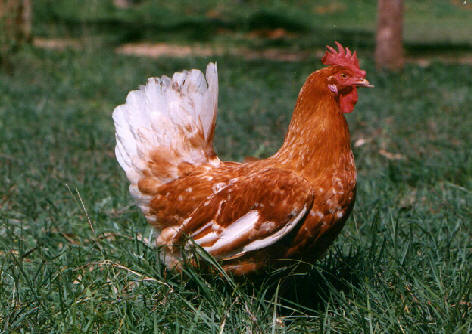
Swarnadhara chickens have a high egg production potential along with better growth compared to other local varieties and are suited for mixed and backyard farming, according to Prof. K. Venkat Reddy, Associate Professor, Department of Poultry Science, Karnataka Veterinary, Animal and Fishery Sciences University (KVAFSU), Hebbal, Bangalore.
The bird can be reared for its eggs and meat. It attains maturity from the 22-23rd week after hatching.
Hens attain a body weight of about 3 kg and the cocks about 4 kg. "Swarnadhara hens lay about 180-190 eggs in a year. This breed yields 15-20 eggs in a year more than Giriraja chicken breed, which was released by the University in 2005.
(For information on Giriraja chicken breed refer The Hindu, Farmers Note Book dated December- 22-2005.)
"Compared to Giriraja breed, Swarnadhara breed are smaller in size with a lighter body weight, which makes them easier to escape attacks from predators such as jungle cats and foxes.
Good Hatchability
Each egg weighs about 55-60 gms," says Prof. Reddy. The eggs have a good hatchability (80-85 per cent) and enable the farmers to raise their own stock. A day-old chick weighs about 35-40 gm.
The eggshell is brown in colour and thicker than that of other commercial eggs and does not break easily.
"The eggs can be stored for 8-10 days at room temperature during summer and during winter for about 15 days.
The eggs are priced between Rs.3 and 5 in the local market," Prof. Venkat Reddy explains.
The birds are only layers and not brooders (that is, they only lay eggs and do not incubate them).
The eggs have to be hatched by local brooder hens. For backyard rearing, a flock of five hens and one cock can be ideally grown.
The birds are sturdy and have a high longevity. No special care is required to grow them.
Local Feed
They can be raised as free roaming birds and can be fed with locally available materials, according to Prof. Venkat Reddy. Being good scavengers, they feed on a variety of insects and green foliage. They can also be fed on farm and kitchen wastes.
"The birds are resistant to major infections except ranikhet and new castle which are common infections in poultry," he says.
Annual Income
A pair of Swarnadhara chicken fetches an income of about Rs.920 a year through the sale of its eggs and meat. One-day-old chicks and eggs of this breed are priced at Rs. 9 and Rs. 5 respectively and are sold at the university campus, according to him.
For more information readers may contact Professor. K. Venkat Reddy, Associate Professor, Department of Poultry Science, Karnataka Veterinary, Animal and Fishery Sciences University (KVAFSU), Hebbal, Bangalore-560024, Phone: (080) 23414384, 23411483 (ext) 201.
The Hindu
Poultry : Weighing and Body Weight Control
Posted by Unknown in Layer Poultry, Poultry Farming

The objective of body weight control is to rear all of the birds to the target weight for age with good uniformity. Body weight targets are achieved by controlling feed allowances.
Feed amounts during rearing are based on body weight and maintenance, whereas in lay they are based on these two factors plus egg production and egg weight.
Feed amounts during rearing are based on body weight and maintenance, whereas in lay they are based on these two factors plus egg production and egg weight.
Feed amounts can only be determined if the body weight is measured accurately every week.
To measure body weight, weigh between 60 - 100 birds per pen each week or 1%-2% of the population.
At 7 and 14 days weigh a bulk sample of birds or 10 birds weighed together in a bucket. Thereafter, weigh birds individually at the same time on the same day of every week. Be sure the bird weights are taken on an “off day” or before feeding if everyday feeding is used.
Follow these simple procedures to ensure accuracy:
- The scales used to measure body weight must have a capacity of 5 kg (11.02 lbs.) and be accurate to +/- 20 g (.04 lbs.).
- Check regularly that the scales are properly calibrated. It is an advantage to have electronic balances with a printout facility.
- Gather approximately 100 birds in a catching pen.
- Weigh every bird in the catching pen, including small birds (cull sexing errors during this operation.)
- Record body weight using the chart.
- Calculate the average weight of all birds weighed.
- Plot the average body weight on the appropriate chart.
- Decide on the feed amount for the following days.
- During rearing, feed amounts should be maintained or increased. Never decrease the feed amount.
- After peak egg production feed amounts are normally reduced to control mature body weight and ensure persistence of egg production and fertility. The precise method of feed reduction could vary from flock to flock, and should be discussed with your Technical Service representative.
Poultry farming in Pakistan
Posted by Unknown in Eggs, Layer Poultry, Meat, Pakistan, Poultry Farming on Sunday, 9 September 2012
Poultry farming in Pakistan has developed as an important sub-sector of livestock

The poultry farming has now become one of the most dynamic associated parts of agriculture throughout the world. Poultry culture in South Asian countries is expanding rapidly and the rate of growth of commercial layer and broiler (meat producing) farms is phenomenal to meet the ever increasing demand for proteins through poultry meet and eggs. In Pakistan, poultry industry had made considerable contribution to food production and plays a vital role in the economy of the country. Raising of poultry in Pakistan has virtually proven a profitable enterprise as it is the best source of cheap, palatable and nutritious food protein. The poultry production commenced in Pakistan in 1963. Hen birds were mostly maintained in the backyard of the houses in villages on a small scale, with very little investment by the villagers in terms of money and material. The return on those birds was too little, and there was hardly any attraction for investments to operate the same on large scales. Poultry as on a commercial scale in the private sector started due to pioneering effect made by PIA in 1965, when the first modern hatchery unit in Karachi was established. Later on, the investments have taken keen interest in this sector, as was result of which substantial development has taken place towards expansion of this industry. The commercial poultry farming emerged through the combined efforts and foresight of the government and the private enterprises. Now commercial poultry production is concentrated around the large urban centers in the provinces of Sindh and Punjab and initially at Karachi, Lahore with the passage of time, it is now fairly well spread all over the country. In the provinces of Sindh, there are farms in Mirpurkhas, Sukhar, Nawabshah as well as in small cities. Similarly, in the province of the Punjab, poultry farms have been well established in the areas of Rawalpindi, Faisalabad, Multan, Lahore, Bhawalpur, Rahimyar Khan, Mianwali. Poultry produced in Pakistan is being developed through two management systems i.e commercial farming and rural poultry farming. The commercial poultry farming sector is a classic example of private ector enterprise with a phenomenal growth of 20 to 25 % per annum. The achievement of this rapid growth was made to the incentives granted by the government from time to time, like liberal financing and credit, income tax exemption, duty free import of grand parent and parent flocks, machinery and poultry farm equipments, such as hatcheries, cages, brooders, feed ingredients such as soybean, meal, maize, and sorghum for use in poultry feeds, in addition to liberal and easy facility to obtain loans from commercial banks and financial institutions. Now the large scale investment and proper incentives have resulted in the establishment of infrastructure comprising of 252 hatcheries with capacity to produce 346 million day- old chicks per annum, 141 feed mills with the capacity to produce 2540 thousand tons of compounds feed per annum and 13154 poultry farms with the capacity to produce 98 million broilers. The present total poultry population is estimated to be 319 million, out of which 137 million is rural (44%), 160 million broilers (50%), 17 million layers (5%) and 5 million breeding (2%) stock annually. These figures speak of the potential that has been established in the country to increase production of eggs and poultry meat thereby reducing further the gap of availability of animal protein foods. Modern poultry farming has a special importance for countries such as Pakistan. Because it is being an easy and relatively cheap method of raising dietary standard of the people. The shortages of animal protein in Pakistan is estimated at 0.93 million tonnes on the basis of human population of 140 million. The average consumption of animal protein is a meager 17g as against the recommended daily requirement of 28g. This shortage of protein can well be managed with increase in the production of poultry meat at a reasonable cost.
Some of the important breeds of the world such as buff rock, leghorn, light Sussex, Rhodes Island red are also hatched successfully in the country at desired traits. A laying bird produces an average of 250 eggs per year and the average live weight of the broiler is recommended as 1200 grams ( or 1.2 kg), at 8 weeks of age. Pakistan produces 6.5 thousand million eggs and 340 thousand tonnes poultry meat. The consumption of poultry feed increased with their ages. It reached its peak (135g/bird/ day) at 25 weeks age. Then it declined slightly reaching 124g / bird/ day at 33 weeks of age. There are also some local breeds, which are highly productive and are more adaptive to the local conditions. These important poultry breeds of fowls are cross bred with each other to produce. The product is concentrated around the large urban centers in the provinces of Sindh, Punjab and NWFP. The majority of such farmers are generally in and around the cities like Karachi, Lahore, Peshawar, and Faisalabad. The capacity of the layers farm varies from 2000 to 20000 birds and that of the broilers farms from 103 to 403 birds per annum. The higher cost of poultry feed is mainly due to the increase in the price of the various ingredients particularly fishmeal in their poultry feed. In these days prices of poultry are very high due to the cost of ingredients needed for the manufacturer of the feed meal.
Approaches to increase production.
In order to increase the production of poultry the following approaches are considered necessary for implementation. Commercial poultry sectors be continued to boost up substantial marine in the productivity.
i) Rural poultry sector be enhanced.
ii) Rearing of traits be introduced on large scale commercial production ducks, partridges and pigeons rearing be introduced. Encourage establishment of poultry farms in private sectors engaged in the production of birds for rural development to improve food availability. Coarse grain production must be increased under target oriented programme like major crops. Price support must be granted. Oil cakes/ meat production can be increased through increasing oilseed crops. To check out easy formula to evolve cheap poultry ratio formulas ratio formula using agriculture and industrial by-products.
To improve poultry health and extension services vaccination against contagious disease must be carried to several 60% of rural poultry production as against existing 25% to establish locally disease reference laboratory.
To establish small poultry units of varying sizes in the villages to increase production of village level. Private sectors be encouraged to establish disease diagnostic laboratory and vaccine production unit to improve poultry marketing. To establish poultry processing plants and cold stores to provide ready market for broilers. To establish poultry marketing center at different places in cities and towns. Price support and broilers may be grounded. This can be implemented through processing plants. To work out cost of production of eggs and to announce whole sale rates of eggs on quarterly basis. To maintain check on the price of day old chicks and poultry feeds to take measure to maintain stability of price and quality. Poultry production during the last 35 years has played a commendable role in shortening the gap of availability of animal protein foods. In order to shorter the gap further within shortest possible time, it has became necessary that poultry, mutton, beef etc are also introduced on small and large scale both in public and private sectors. The possible feasible sources are rear of quails, ducks, pheasant, partridges, pigeons etc. All these sources are quite producing with short duration. It is observed that with the introduction of these techniques, the gap of animal protein food will be minimised within a short period.
Poultry feed and prices: Poultry feed gained importance with the emergence of poultry farming on a wide scale in the country. At present, poultry feed is produced by commercial feed mills as well as by home mixture. There are several feed mills located in the different parts of main cities of Pakistan. The different ingredients required for making poultry feed are broken or coarse grains (wheat, rice, maize, millet, sorghum barley, dried sea food, dried blood of animals, broken pulses and different vitamins). The poultry feed by its quality and price is the major factor in determining the cost of poultry products i.e. eggs and broilers and profitability of the poultry farm. The prices of feed have been constantly increasing. Due to recent global changes in the price structure of the cereal grains and other feed stuffs, the poultry industry at present is handicapped on account of high feed cost which have gone over to more than 60% of the total cost of production.
Advantages: The poultry meat and egg production over many decades have shown positive growth in the overall performances of the livestock sector and it has now reached a stage where its impact is obvious on the national economy of the country. The supply of eggs and poultry methods based on two distinct methods of production small scale village production and modern commercial methods in and around big cities. Poultry keeping business is one of the most promising source of additional income. Besides, this poultry farming has a number of advantages. It produces much needed protein, food, it serves as a source of income and employment to many and it has good returns. Poultry keeping is becoming more and more capital intensive, and it is very profitable. The income from poultry business begins to emerge within 8 to 9 weeks for broiler or 20 to 22 weeks for layers. A broiler is a young male or female bird under the age of 10 weeks. These are generally fast growing breeds reared and marketed for meat. Depending on feed and management broiler mature in 8 weeks weighing nearing 2-2.5 kg and the broiler consume about 4 kg of feed in the period of 6 to 8 weeks is the usual age for marketing. Most breeders rear broilers to be ready for sale during festivals when demand of profit is high. A layer of mature age generally lays 250 -300 eggs. These eggs provide high quality protein to the house hold. In addition to eggs and meat poultry provide manure that is of great value on the farm. It has been observed that nearly 40 hens or deep litter yields about 1000 kg of manure per year. The income from layers (hens) begins to appear within 8 to 10 weeks, for broilers or 18 to 20 weeks for layers. According to the economic survey (94-95), 2.35 kg / capita per year eggs were available in Pakistan during this period.
Disadvantages: It is a well known fact that poultry farming is a profitable business but it has also some disadvantages some disease such as Newcastale disease, Marek's disease, infectious bronchitis, gum-boro disease, fowl pox, myco-plasmosis, coccidiosis, lymphoid, adino virus hydro-pericardium etc. are very common in the poultry chicken. These diseases affect very quickly and have a tremendous effects on the growth of the birds. The excess uses of meat also has ill-effects on the health of their users, because the feed they eat contains lots of unhygenic ingredients. Therefor the chickens should be vaccinated regularly and properly.
Conclusion: It has been observed during the last thirty five years that poultry farming in Pakistan has developed as an important sub-sector of livestock This expansion continues to fill the genuine gaps of the animal protein and should be fully encouraged in order to promote the welfare and prosperity of the people by providing them with a nutritious balanced diet.
By Dr. S. M. Alam and M. A. Khan
Nuclear Institute of Agriculture
Tando Jam, Pakistan
What Do Chickens Eat? A Guide to Chickens Food
Posted by Unknown in Alfalfa (Lucerne), Chicken, Feed, Layer Poultry, Poultry on Saturday, 8 September 2012

What do chickens eat?
Our chickens food guide will show you what to feed chickens, as well as your options for how to feed chickens.
Learn how to raise chickens in backyards and small farms for optimal self sufficiency, health and productivity.
Meeting the Nutritional Needs of Chickens
Chickens are production animals and so demand a nutrition-dense diet. Even if you are keeping chickens as pets, they still need plenty of nutrients to grow and lay eggs.
Feeding and Types of Chickens
What do chickens eat depends significantly on the types of chickens you are feeding, and whether you are raising chickens for eggs, or growing chickens for meat.

As this table shows, growing chicks have high protein requirements, and those being grown commercially for meat need the most.
On such a rich diet, commercial meat chickens normally reach their table weight by the tender age of just 7 weeks.
On the small farm or backyard it is often more practical to feed rooster and hen chicks together regardless of their different destinies.
However, expect such roosters being grown for the pot to take more than twice as long as commercial birds to reach a respectable size for eating.
Laying hens also have a relatively high protein requirement, as well as needing a lot of calcium, much of which goes straight out again as eggs.
And of course, chickens also need a whole range of other minerals, vitamins and fatty acids to thrive.
What Do Chickens Eat?
Here we’ll mainly concentrate on meeting the prodigious nutritional needs of the laying hen. However, most of this dietary information can be applied to other chickens; just remember though that non-layers need a lot less calcium!
***This is important as giving high calcium (i.e. layer) rations to other chickens, such as growing chicks, can cause kidney damage. ***
Another important point: never feed spoilt or mouldy feed to your birds. Feed is best fed fresh so don’t buy more than what you would expect to use within a few weeks.
And no matter what diet source you go for, make sure your chickens get plenty of fresh greens (weeds, vegetables, grass) every day.
Something to Think About If Raising Chickens for Eggs…
Laying an egg every day is no mean feat… Nutritionally it is akin to a woman giving birth to a full-term baby once a week!
No wonder failure to provide a quality, balanced ration is a common reason for poor egg production when raising chickens for eggs at home.
So, what is the best way to meet the prodigious nutritional needs of the laying hen? There are several options…
What Do Chickens Eat – Your Options!
We’ll cover a full range of options for what to feed chickens – from wholly commercial to the fully self sufficient option suited to raising organic chickens.
Commercial Layer Ration Only
What do chickens eat when you are too busy to mix or grow your own feeds?
By far the easiest option is to buy a high quality feed specifically formulated for laying hens from your local livestock outlet.
This should contain everything your layers need in the correct balance, including grit, vitamins and minerals.
Provide these rations ad lib, so that your hens can have as much as they want at any time.
Commercial layer rations can be in the form of seed mixes, pellets or crumbles. Use a poultry hopper, just half full and elevated to hen head height to avoid waste.
Expect each laying hen to use about ¼ lb (114 gms or half a cup) of commercial chickens food a day.
Supplemented Layer Ration…
What do chickens eat when grain is cheaply available in your local area? Yes, you can significantly cut your feed costs by supplementing commercial rations using cheap local grain.
The best solution is to feed the grain free choice (around 50 grams per hen per day) either in hoppers or spread on the ground amongst deep clean litter to encourage scratching, along with a higher protein (20 to 22%) laying feed.
If using a complete 16% protein laying feed, cut the grain fed down to half of this amount or your hens will get too fat.
You can also add surplus fresh or sour milk, stale bread, table scraps, pasture and garden waste to further cut the amount of commercial feed needed.
Consider local supplies of these resources – such as the waste from restaurants, bakeries, lawn-mowing contractors, fruit and vegetable outlets…
Whenever you are not using 100% commercial rations you need to also provide:
• Extra grit for all chickens.
What do chickens eat to compensate for having no teeth? Grit! Grit is needed by chickens to help grind seeds in their stomach, taking the place of teeth! It can be in the form of fine gravel or small, sharp granite chips.
• Extra calcium for laying hens.
The formation of egg shells requires considerable amounts of calcium. Provide it free choice as either calcium grit, natural lime sand, or oyster shell.
You can also recycle egg shells back to your hens after first washing the albumen off them (to prevent bacterial growth), then drying and crushing them.
Home Mixed Feed
Commercial rations can contain some unsavory industrial waste products such as sewerage, brew yeast or citrus sludges, as well as medicants such as antibiotics or coccidiostats.
So what do chickens eat when you are raising organic chickens or simply prefer a purer, fresher, more wholesome diet for your chooks?
One option is home mixed feed. It is not without its problems though.

Apart from the time and trouble of ensuring a balanced ration, I’ve done some calculations on home mixing my own “complete” chickens feed from bought ingredients and found the commercial feeds a cheaper option.
You just can’t compete on price with the big feed mills! If you can grow your own grains this is not such an issue though.
To do this right you must find the best and most cost effective local sources of protein and carbohydrates, and provide these in balance with sufficient calcium and grit to meet your chickens nutritional needs (see chart above).
Ideally, what do chickens eat when they are layers?
16-17% of the diet (by weight) should be protein. Wheat only has 12.5% protein. How do you make up the difference? By feeding the grain (wheat in this case) with a high protein feed.
Here is the protein content of some potential chicken food ingredients:

IMPORTANT… WHEN FEEDING PEAS OR BEANS!
Grain legumes such as peas and beans contain Trypsin inhibitors that not only reduce the availability of protein in the feed, but can also damage the bird’s pancreas causing chronic illthrift.
To use grain legumes you must first prepare beans or peas in such a way that you destroy the Trypsin inhibitors. This is usually done using heat – keeping them at or above 180°F (82°C) for at least 15 minutes.
The most effective method is:
1. Soak enough legumes to feed your chickens for a few days overnight in water.
2. Bring the whole lot to the boil then simmer for 15 minutes.
3. Cool and refrigerate.
4. Feed directly to your chickens (e.g. a heaped tablespoon of boiled soybeans per bird per day).
Here is a sample ration (parts are by weight):
52 parts Wheat24 parts prepared (boiled) Lupins or Soybeans 14 parts Meat Meal13 parts Corn9.5 parts Lime Sand (38% Ca)9.4 Skim Milk powder4.7 parts Sunflower Seeds0.4 parts Iodized Salt
What do chickens eat for vitamins and minerals?
Essential vitamins and minerals can be provided either in the form of a special proprietary preparation, or as dried kelp collected from the beach, as well as daily nutritious weeds, herbs and vegetables picked from your garden (see the home grown section below for more details).
Self Sufficient, Home Grown Option
What do chickens eat when, like us, you are striving to be as self sufficient as possible? The question is more important than you might at first believe.
Bought chickens food (as well as humans’ food!) of all kinds is destined to become increasingly scarce and expensive due to the twin influences of peak oil and climate change.
Add global economic collapse to the mix and it makes increasing sense to plan for self sufficiency now rather than for continued dependence on purchased inputs to your system.
And if your aspiration is raising organic chickens, it is even more crucial to grow as much of their food (organically of course) as you can.
So how do you grow your own chickens food?
We must start by reconsidering their nutritional needs (outlined above) for protein, carbohydrate, calcium, minerals, vitamins and grit and how we might meet them.
What do chickens eat for Protein?
There are several options on what to feed chickens to meet their protein needs at home.
Earthworms
Do chickens eat worms? Absolutely! And just as well, as they are a rich source (28%) of high quality protein as well as “good” fats and other nutritious yummies.
Earthworms are also easy to grow, converting almost any organic waste material – from used tea bags, paper and potato peels, to horse manure, weeds, hair and vacuum cleaner dust - into a primo poultry food ingredient.
Under ideal conditions earthworms reproduce rapidly. Grown on horse manure, one square meter can yield 1.7 kg of earthworm protein a year, enough to exceed the protein needs of 1 hen.
You can either grow your earthworms in special worm farms and feed them out to your gals, or grow them in the rich soil of your specially designed organic vegetable garden system and let the hens help themselves, while doing valuable work for you at the same time.
Other High Protein Fodders to Grow
• Alfalfa (Lucerne):
High protein and a good source of several vitamins and minerals, Lucerne is a perennial plant that can yield 0.3 kg of protein per m2 per year when irrigated.
We grow it specially for our hens and chop a good handful of the young fresh growth each day into their feed.
• Duckweed:
If you have greywater you wish to purify, duckweed (Lemnaceae) will do the job for you. Duckweed is a valuable feed supplement.
It has high concentrations of trace minerals, and its protein is extraordinarily rich in the essential amino acids, lysine and methionine. Each square meter of pond would yield around 0.4 kg of protein per year.
• Comfrey:
Comfrey provides a protein and mineral-rich feed which can effectively replace some costly concentrates in the poultry diet.
In summer four to five comfrey plants per hen can meet much of their protein and calcium needs. In winter, when the plant dies down, alternative sources need to be found.
Being less fibrous than Lucerne, it is much better suited to the digestive system of chickens.
With a dry matter protein content of between 15% and 30%, comfrey is as valuable a protein source as legumes. It is also rich in vitamins and minerals, particularly calcium, potassium, phosphorus and iron, as well as magnesium, sulphur, copper, zinc, selenium and germanium.
What do chickens eat for Carbohydrates?
All animals need carbohydrates for energy. For the laying hen about 80% of the diet should be carbohydrate. The most concentrated sources are the grains – wheat, barley, rice, oats, as well as vegetable seeds that chickens integrated with Permaculture vegetables can access.
Unless you are growing these yourself, or can get a steady supply of stale bread from your local baker, you’ll need to purchase grain locally. Luckily it is relatively cheap.
Hens totally unsupplemented with commercial rations may need from 50 to 100 grams of grain each per day, depending on what else they are eating and the season (feed more in cold weather).
What do chickens eat for Calcium?
Calcium is best made available to laying hens ad lib as crushed oyster shell or cuttlefish, or sprinkled in appropriate quantities on other feeds as crushed limestone (lime sand).
Various foods are rich in calcium and can also be included in your chickens’ diet. These include many green leafy vegetables (e.g. collards or mustard greens), brewer’s yeast, oats, milk, kelp, cooked beans and peas, sunflower and sesame seeds.
Herbs and vegetables you can grow for your girls which are known to be high in calcium include: dandelion, chickweed, mustard greens, kale, cabbage, dandelion, watercress, parsley, comfrey, plantain, nettles, raspberry (leaves), alfalfa, red clover, horsetail and chamomile.
Many of these can be served fresh, dried or sprinkled over fresh food.
Fresh watercress (Nasturtium officinale) in particular is highly nutritious, providing 4% calcium, 3% protein, just over 1% phosphorus, and a very good source of other important vitamins and minerals.
What do chickens eat for Minerals?
Your hens will get much if not all of their mineral needs from the many herbs and vegetables they get access to from your organic garden system.
If you are, however, keeping them in a simple run, kelp fronds make a very good source of essential minerals in the right combination for good health.
Simply collect some from a clean beach, then hang whole from a sturdy clip inside the run for the chickens to help themselves.
We make up our own inexpensive multimineral multivitamin preparation for supplementing all our animals and even ourselves.
Here is our recipe:
• 1 part (by volume) Torula or Brewers Yeast powder
• 1 part Lecithin granules
• 1 part Kelp powder or granules
Combine ingredients and store in the fridge in an airtight container. Give at the rate of 1 flat teaspoon per hen twice a week mixed into other food.
What do chickens eat for Grit?
On your travels, look out for deposits of sharp grit of granite, gravel or other hard rock and collect a variety of sizes. Offer the smallest to young chicks and the larger ones to adult birds.


