Showing posts with label Breeds. Show all posts
15 Most Popular Domestic Geese Breeds
Posted by Unknown in Breeds, Ducks and Geese on Tuesday, 14 May 2013

|
15 Domestic Geese
Breeds
|
||||
|
Buff
Back
|
African
|
Chinese
|
Twente
Landrace
|
Pommeranian
|
|
Toulouse
|
American
Buff
|
Pilgrim
|
Steinbacher
|
Egyptian
|
|
Embden
|
Sebastopol
|
Canadian
|
Brecon Buff
|
West of
England
|
Boer Goat Breed Standards
Posted by Unknown in Breeds, Cattle and Livestock, Goat on Sunday, 27 January 2013

GENERAL APPEARANCE & TYPE
In
the Doe there is strong emphasis on femininity; in the Buck one of
masculinity. The general appearance is a goat with a fine head, round
horns bent backwards; a loose, supple and pleated skin (especially in
bucks) with different body parts well fleshed in balance. The doe should
appear feminine, wedging slightly to the front. The buck should appear
heavier in the head, neck and forequarters. The Boer goat is an animal
with symmetry, as well as a strong and vigorous appearance.
CONFORMATION
HEAD
A
strong head with large soft brown eyes. A strong slightly curved nose,
wide nostrils, strong well formed mouth with well-fitted jaws. Up to 4
teeth must show a 100% fit. Six tooth and older may show 6 mm
protrusion. Permanent teeth must cut in the correct place. The forehead
must be prominently curved, linking up with the curve of nose and horns.
For animals that are not disbudded, horns should be strong, of moderate
length and placed moderately apart with a gradual backward curve. Horns
have to be as round and solid as possible and coloured darkly. Ears are
to be broad, smooth and hanging downwards from the head.
UNDESIRABLE CHARACTERISTICS
Concave
forehead, horns too straight or flat, pointed jaw, stiff protruding
ears, short ears, jaws and blue eyes. Over or under-shot jaw.
NECK AND FOREQUARTERS
A
neck in proportion to the length of the body, full and well fleshed and
well joined with the forequarter. The breastbone should be broad with a
deep broad brisket. The shoulder should be fleshy, in proportion to the
body and be well fitted to, the withers. The withers should be broad
and well filled. The front legs should be in proportion to the depth of
the body. The legs should be strong and well placed, with strong pastern
joints and well-formed, dark hooves.
BARREL
The
ideal is a long, deep broad barrel. The ribs must be well sprung and
fleshed, with a long loin. The goat should have a broad back and
reasonably level topline.
UNDESIRABLE CHARACTERISTICS
Sway or saddle back or pinched behind the shoulder.
HINDQUARTERS
The
Boer Goat should have a broad and long rump, with a slight slope, well
muscled buttocks and thighs. The tail must be straight where it grows
out of the dock and may swing to either side.
UNDESIRABLE CHARACTERISTICS
Steep or short rump; wry tail or flat buttocks.
LEGS
The
legs should be strong and well placed. Too fleshy legs are undesirable.
Strong legs imply hardiness and a strong constitution, which are
absolutely essential characteristics of the Boer Goat.
UNDESIRABLE CHARACTERISTICS
Knock knees, bandy legs, thin legs. Weak pasterns and hoofs pointing outwards or inwards.
SKIN AND COVERINGS
A
loose supple skin with sufficient chest and neck folds, especially in
the case of bucks. Eyelids and hairless parts should have a minimum of
75% pigmentation. Short glossy hair(except during winter months).
SEXUAL ORGANS
DOES:
Well-formed
udder firmly attached with no more than two functional teats per side.
One teat on each side or two teats per side; well separated is
desirable.
UNDESIRABLE CHARACTERISTICS
Fish or cluster teats; blind teats.
BUCKS:
Two
reasonably large, well formed, healthy and equal sized testes in one
scrotum. The scrotum should be at least 25 cm in circumference at one
year of age. One teat or two teats per side is desirable.
UNDESIRABLE CHARACTERISTICS
Fish or cluster teats A scrotum with more than A 5 cm split.
COLORING
Ideal coloring for a Traditional Boer Goat (TR) and a Canadian Purebred Boer Goat (CR) is a white body with reddish brown head.
E-mail am@ramhbreeders.com
Bald Chicken 'Needs No Plucking'
Posted by Unknown in Biotechnology, Breeds, Chicken on Friday, 25 January 2013

Bald Chickens
(BBC News) Scientists have bred a controversial featherless chicken which they say is faster growing.
The birds, created at the Hebrew University in Israel, will not need to be plucked, saving money in processing plants.
While
the researcher behind the breed concedes that they would not be
suitable for cooler countries, he says that in hot climates, the birds
would fare better.
However,
opponents of the move say that the changes do not benefit the animals,
and are in fact likely to make their lives worse.
Professor
Avigdor Cahaner, who led the project, told the BBC: "This is not a
genetically modified chicken - it comes from a natural breed whose
characteristics have been known for 50 years.
"I am just transferring that to fast growing broiler chickens. It's a normal chicken except for the fact it has no feathers."
He
said that broiler chickens were fed intensively to achieve fast growth,
which meant they also tended to produce a lot of body heat; and this
meant that particularly in hotter countries, they "suffer tremendously".
The
featherless birds would tend to be leaner, and perhaps grow faster, he
said, which would improve the quality of the meat and save producers
money.
Pollution claim
Removing
the plucking process would also reduce pollution, he said. The process,
he claimed, produced large quantities of water contaminated with
feathers and fat.
However,
animal welfare groups warned that feathers were important to help
protect the birds from parasites - and that the featherless chickens
were likely to suffer sunburn.
In addition, male chickens might not be able to mate, they argued.
Swarnadhara poultry breed's benefits, no chicken feed
Posted by Unknown in Breeds, Chicken, Layer Poultry, Poultry, Zz_Wordpress on Monday, 10 September 2012
M.J. PRABU
The eggshell is brown in color and thicker than other commercial eggs |
| MORE YIELD: The birds lay about 180-190 eggs in a year. |
IN AGRICULTURE, even with the best crop production strategies and technical expertise, there is no guarantee that the yield will be bountiful.
Agricultural experts have always been advising farmers to grow multicrops instead of monocrops and rear cattle, goats and poultry along with their crops, because even if the crops fail, the animals and their produce will help the farmers overcome their financial losses.
Hardy Birds
Compared to cattle and goats, which require a hefty investment, farmers can rear country chickens (having coloured plumage) as these birds are hardy, require less space for growing and fetch a good price for their meat and eggs.
The development of a hybrid chicken breed named Swarnadhara by researchers at the Department of Avian Production and Management (DVPM), Hebbal, Bangalore will go a long way to meet the above criteria.
High Egg Production
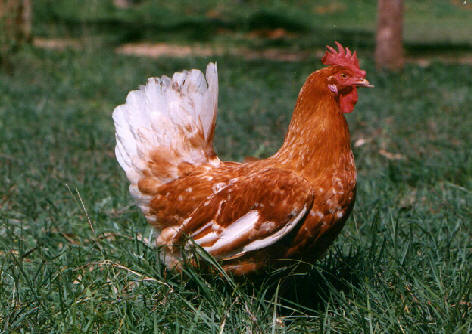
Swarnadhara chickens have a high egg production potential along with better growth compared to other local varieties and are suited for mixed and backyard farming, according to Prof. K. Venkat Reddy, Associate Professor, Department of Poultry Science, Karnataka Veterinary, Animal and Fishery Sciences University (KVAFSU), Hebbal, Bangalore.
The bird can be reared for its eggs and meat. It attains maturity from the 22-23rd week after hatching.
Hens attain a body weight of about 3 kg and the cocks about 4 kg. "Swarnadhara hens lay about 180-190 eggs in a year. This breed yields 15-20 eggs in a year more than Giriraja chicken breed, which was released by the University in 2005.
(For information on Giriraja chicken breed refer The Hindu, Farmers Note Book dated December- 22-2005.)
"Compared to Giriraja breed, Swarnadhara breed are smaller in size with a lighter body weight, which makes them easier to escape attacks from predators such as jungle cats and foxes.
Good Hatchability
Each egg weighs about 55-60 gms," says Prof. Reddy. The eggs have a good hatchability (80-85 per cent) and enable the farmers to raise their own stock. A day-old chick weighs about 35-40 gm.
The eggshell is brown in colour and thicker than that of other commercial eggs and does not break easily.
"The eggs can be stored for 8-10 days at room temperature during summer and during winter for about 15 days.
The eggs are priced between Rs.3 and 5 in the local market," Prof. Venkat Reddy explains.
The birds are only layers and not brooders (that is, they only lay eggs and do not incubate them).
The eggs have to be hatched by local brooder hens. For backyard rearing, a flock of five hens and one cock can be ideally grown.
The birds are sturdy and have a high longevity. No special care is required to grow them.
Local Feed
They can be raised as free roaming birds and can be fed with locally available materials, according to Prof. Venkat Reddy. Being good scavengers, they feed on a variety of insects and green foliage. They can also be fed on farm and kitchen wastes.
"The birds are resistant to major infections except ranikhet and new castle which are common infections in poultry," he says.
Annual Income
A pair of Swarnadhara chicken fetches an income of about Rs.920 a year through the sale of its eggs and meat. One-day-old chicks and eggs of this breed are priced at Rs. 9 and Rs. 5 respectively and are sold at the university campus, according to him.
For more information readers may contact Professor. K. Venkat Reddy, Associate Professor, Department of Poultry Science, Karnataka Veterinary, Animal and Fishery Sciences University (KVAFSU), Hebbal, Bangalore-560024, Phone: (080) 23414384, 23411483 (ext) 201.
The Hindu


