Showing posts with label Drought. Show all posts
Alfalfa in Forage System Extends Feed in Drought
Posted by Unknown in Alfalfa (Lucerne), Drought, Silage and Forage on Friday, 29 March 2013

Written by Duane Dailey,
University of Missouri Cooperative Media Group
Another drought year ahead or not, adding more forages to the grazing mix helps during the annual summer slump, says a University of Missouri Extension forage specialist.
Rob Kallenbach advocates more alfalfa, although the legume called “the queen of forages” has fallen out of favor with some farmers.
Planting alfalfa can boost production on any pasture-based livestock farm, Kallenbach says.
“Yields in 2012 were an eye-opener for those who had alfalfa in their forage mix,” he adds. “Alfalfa kept growing long after other crops had dried up and died. The deep-rooted legume was noticeably greener.”
Drought brings renewed interest in establishing the protein-rich and nutrient-rich legume.
Kallenbach admits alfalfa is a picky plant. “It likes deep, rich, well-drained soils. Alfalfa won’t tolerate wet feet.”
But the legume responds well to good management, especially when lime, phosphorous and potash levels are kept up to soil-test recommendations. “Alfalfa pays well for extra attention. With a little care, it grows more tonnage per acre.”
In addition, the legume fixes enough nitrogen for its own use. That cuts fertilizer costs.
Almost every farm big enough to maintain a livestock herd has some land that will grow alfalfa, Kallenbach says. A 1,000-acre farm with 300 cows will have 80 or 100 acres suited for alfalfa.
While he favors the prime legume, every farm can benefit from clovers, red and white, and lespedeza seeded into grass pastures. Those legumes extend grazing into the summer slump.
Clover’s big advantage is ease of establishment. The legumes can be frost-seeded into grass pastures in February. However, grasses must be grazed down short before seeding. That allows seedlings to get started in the spring. Tall grass makes too much competition.
Kallenbach’s main message: Diversify forage beyond toxic tall fescue, Missouri’s dominant pasture forage.
Warm-season grasses also hold up well in what are the usual summer dry spells. They can extend the grazing season.
“Last summer, the drought-tolerant species delayed need to start feeding hay,” Kallenbach says. “However, in extreme droughts nothing keeps growing without rain. The cool-season grasses dry up early.”
Grazing provides less-expensive feed than baled hay. A dry-weather grazing plan requires advance planning. Many producers started feeding baled hay in July last summer because of grass shortages.
Summer grazing also comes from annual warm-season grasses such as sorghum-sudan and pearl millet. However, they must be planted when there is moisture in the soil. “If you wait until going into a drought, it’s too late to plant supplemental forages,” Kallenbach says.
All forages benefit from managed grazing. With rotational grazing, dividing large pastures into grazing paddocks, less forage is lost to trampling. The rest periods in management-intensive grazing boost production of forage per acre.
Forage that cows waste in continuously grazed pastures could have been used to replace high-priced baled hay.
Dry-weather grazing may become the new norm, according to some climatologists looking at long-range forecasts.
Mixed-species pastures with managed grazing may become part of the survival of beef herds in Missouri.
For Kallenbach, better grazing plans include alfalfa. It has a bright future on more Missouri farms, he says. Even if drought doesn’t come, alfalfa producers have high-tonnage forage to be grazed, baled or put up as baleage.
If not needed on the home farm, alfalfa becomes a highly marketable feed. Someone, somewhere, will need it and be willing to pay big bucks for it.
—From University of Missouri Cooperative Media Group
University of Missouri Cooperative Media Group
Another drought year ahead or not, adding more forages to the grazing mix helps during the annual summer slump, says a University of Missouri Extension forage specialist.
Rob Kallenbach advocates more alfalfa, although the legume called “the queen of forages” has fallen out of favor with some farmers.
Planting alfalfa can boost production on any pasture-based livestock farm, Kallenbach says.
“Yields in 2012 were an eye-opener for those who had alfalfa in their forage mix,” he adds. “Alfalfa kept growing long after other crops had dried up and died. The deep-rooted legume was noticeably greener.”
Drought brings renewed interest in establishing the protein-rich and nutrient-rich legume.
Kallenbach admits alfalfa is a picky plant. “It likes deep, rich, well-drained soils. Alfalfa won’t tolerate wet feet.”
But the legume responds well to good management, especially when lime, phosphorous and potash levels are kept up to soil-test recommendations. “Alfalfa pays well for extra attention. With a little care, it grows more tonnage per acre.”
In addition, the legume fixes enough nitrogen for its own use. That cuts fertilizer costs.
Almost every farm big enough to maintain a livestock herd has some land that will grow alfalfa, Kallenbach says. A 1,000-acre farm with 300 cows will have 80 or 100 acres suited for alfalfa.
While he favors the prime legume, every farm can benefit from clovers, red and white, and lespedeza seeded into grass pastures. Those legumes extend grazing into the summer slump.
Clover’s big advantage is ease of establishment. The legumes can be frost-seeded into grass pastures in February. However, grasses must be grazed down short before seeding. That allows seedlings to get started in the spring. Tall grass makes too much competition.
Kallenbach’s main message: Diversify forage beyond toxic tall fescue, Missouri’s dominant pasture forage.
Warm-season grasses also hold up well in what are the usual summer dry spells. They can extend the grazing season.
“Last summer, the drought-tolerant species delayed need to start feeding hay,” Kallenbach says. “However, in extreme droughts nothing keeps growing without rain. The cool-season grasses dry up early.”
Grazing provides less-expensive feed than baled hay. A dry-weather grazing plan requires advance planning. Many producers started feeding baled hay in July last summer because of grass shortages.
Summer grazing also comes from annual warm-season grasses such as sorghum-sudan and pearl millet. However, they must be planted when there is moisture in the soil. “If you wait until going into a drought, it’s too late to plant supplemental forages,” Kallenbach says.
All forages benefit from managed grazing. With rotational grazing, dividing large pastures into grazing paddocks, less forage is lost to trampling. The rest periods in management-intensive grazing boost production of forage per acre.
Forage that cows waste in continuously grazed pastures could have been used to replace high-priced baled hay.
Dry-weather grazing may become the new norm, according to some climatologists looking at long-range forecasts.
Mixed-species pastures with managed grazing may become part of the survival of beef herds in Missouri.
For Kallenbach, better grazing plans include alfalfa. It has a bright future on more Missouri farms, he says. Even if drought doesn’t come, alfalfa producers have high-tonnage forage to be grazed, baled or put up as baleage.
If not needed on the home farm, alfalfa becomes a highly marketable feed. Someone, somewhere, will need it and be willing to pay big bucks for it.
—From University of Missouri Cooperative Media Group
Impact of Drought: Thirsty Markhors Descend from Highlands
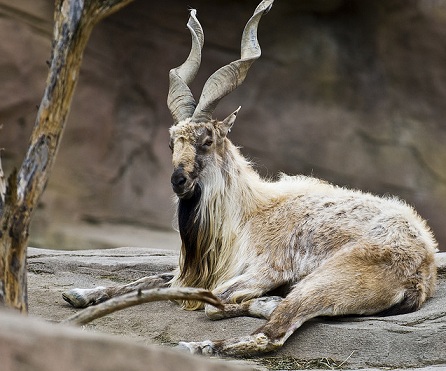
The
ongoing drought in Gilgit-Baltistan (G-B) has forced the region’s
endangered and highly precious Markhors to descend from their habitats
in search of water.
About
a dozen Markhors were seen last week on a mountain adjacent to the
Karakoram International University (KIU), situated on the junction of
Gilgit and Hunza River.
The herd returned after having water.
Conservationists blame the ongoing drought for the Markhors’ descent from their habitat in highlands.
“Wild
animals come down, searching for water, when drought persists,” said
Ghulam Mustafa, a conservationist in Gilgit, the region’s capital city
which is yet to receive its first snowfall or rains for this winter.
The descent also puts this precious species, whose trophy hunting fee in international market is over $55,000, in grave danger.
Protecting the species
Given
the species’ endangered status and importance, the university has taken
steps to provide security and water for the animals at appropriate
points.
After
sighting the rare species around KIU, the university management called
an emergency meeting to facilitate the wild animals searching for water,
an official at KIU told The Express Tribune.
“The director estates and security at KIU
was assigned the task of arranging security and water at appropriate
points for the wild animals, which are often subject to illegal
hunting,” the official added.
“It
will be a good idea if some water is stored at some elevation so that
the herd does not need to come down in the settlements,” said Director
Estates and Security Maj (retd) Altaf Hussain.
He added that he made a visit to the possible route of the specie and devised a plan for storing water and some food.
“It is our collective responsibility to conserve the unique biodiversity of this region,” he added.
Shabbir Mir
The Express Tribune


