Showing posts with label Animal Health. Show all posts
Can We Get Antibiotics Out of the Meat Industry?
Posted by Unknown in Animal Health, Cattle and Livestock, Meat, Medicine and Antibiotics, Poultry on Friday, 25 January 2013
I
have a distinct memory from a few years back, when anti-bacterial soap
and the like first became popularized, involving the Utopian promise of
wiping out all bacteria (good and bad) from hands, feet, countertops,
etc. While this promise of a cleaner and more sanitary world had its
appeal, I (along with a few other wary skeptics) wondered if the
eradication of all bacteria was such a good idea; that maybe this
pathogen-free promise was going to bring along unforeseen problems.
Well, we have yet to see the result of our anti-bacterial boon, but in
the fight against disease and pathogens with the use of antibiotics, we
humans have seen spotted trouble on the horizon – especially in relation
to factory farm-raised livestock.
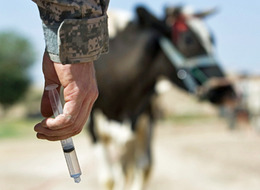
As
a brief primer to the whole issue of livestock (or animals as some of
us tend to overlook) and antibiotics; industrial farms throughout the
United States have been mixing antibiotics into livestock feed since
1946, when studies showed that the drugs cause animals to grow faster
and put on weight more efficiently, increasing meat producers’ profits.
The primary reason that animals are fed antibiotics is because they are
fed a low cost, high calorie corn based diet. This is also the reason
the livestock tend to gain weight so quickly (as much as 70 percent of
all antibiotics used in the United States is fed to healthy farm
animals). Add to this the close confinement these animals are kept in,
as well as the stress and lack of sanitation that many of these animals
contend with, it is no wonder that they become prone to infection and in
desperate need of antibiotic treatment in order to stay alive for as
long as necessary.
But
the liberal use of antibiotics present more complex and knotty
challenges than just ethical ones. According to a New York Times report,
dispensing antibiotics to healthy animals is routine on the large,
concentrated farms that now dominate American agriculture. But the
practice is increasingly condemned by medical experts who say it
contributes to a growing scourge of modern medicine: the emergence of
antibiotic-resistant bacteria, including dangerous E. coli strains that
account for millions of bladder infections each year, as well as
resistant types of salmonella and other microbes. It has been estimated
that at least 18,000 Americans die every year from such drug-resistant
infections, many of which are attributed to liberal antibiotic use.

Now,
contributing to what may be a banner year for the Food and Drug
Administration (FDA), the FDA intends to put its proverbial food down
with new tighter guidelines that would effectively end farm use of these
antibiotic drugs simply to promote faster animal growth. In addition,
the FDA is calling for tighter oversight by veterinarians in an effort
to reduce what it calls a clear risk to human health. All of this FDA
movement comes at a time when vocal criticism of factory farms and
animal confinement has reached a fever pitch, and will undoubtedly be a
welcome relief to the long established status quo. However, not everyone
is looking forward to these tighter regulations, namely livestock
producers who don’t see the direct connection between factory farms,
antibiotic resistant bacteria, and outbreaks of human illness. In
addition, many in the factory farm business argue that more stringent
guidelines on antibiotic use would lead to more animal fatalities and
ultimately a more costly end product. However, the EU barred most
nontreatment uses of antibiotics back in 2006 and farmers there have
adapted without major costs. And it has been proven over the years, in
many different locals with sustainable farms, that animals raised in a
clean, natural environment that is not a breeding ground for bacteria
actually do better than their antibiotic-treated counterparts.
It
is too early to see how all of this shakes out, but in a year where
progressive legislation has been authored to reform egg farms, and a
general growing awareness of the shortfalls of the factory farm model,
it feels like a move in the right direction, especially after the FDA’s
relative inaction over the past decade. I would imagine that many of you
have strong feelings about the current status of factory farms and
their liberal use of antibiotics. I don’t even feel I need ask pointed
questions, as many of you will happily sound off without provocation
below. But please, I invite everyone to share your take on the current
state of being and what is needed for a happier, healthier, and maybe
more ethical food system.
Eric
Steinman is a freelance writer based in Rhinebeck, N.Y. He regularly
writes about food, music, art, architecture and culture and is a regular
contributor to Bon Appétit among other publications.
Health Authorities Still Search for Cause in Bird Flu Death
Posted by Unknown in Animal Health, Bird Flu, Chicken, Poultry

(Xinhua)
-- Health authorities in south Guangdong province have yet to find the
cause of the highly pathogenic H5N1 virus, commonly known as bird flu,
that led to the death of a bus driver, a local disease control official
said Sunday.
The
39-year-old man surnamed Chen in Bao'an district of Shenzhen was
hospitalized for fever on Dec. 21 and tested positive for the H5N1 avian
influenza virus. He died of multiple organ failure Saturday afternoon,
the Guangdong Health Department said in a statement.
The
department also said that during the previous month prior to his fever,
he had no direct contact with poultry and hadn't traveled out of the
city.
Chen's
wife said he had a habit of doing morning exercises every day near a
wetland park and an artificial lake not far from his home, but "no proof
has been found that his infection is connected with the migratory birds
there," He Jianfeng, director of the Epidemics Studies Institute of the
Guangdong Disease Control Center, said Sunday.
"We also don't know whether he had eaten poultry before he fell ill," He said.
He said contacts with poultry and migratory birds are two ways for humans to be infected with bird flu.
"But
Chen had been in coma after being hospitalized, so we couldn't inquire
about what birds or poultry he may have had contact with," he said.
The
General Administration of Quality Supervision, Inspection and
Quarantine (AQSIQ) on Dec. 22 suspended supplies of live poultry to Hong
Kong after a dead chicken tested positive in Hong Kong for the highly
pathogenic H5N1 virus.
The
AQSIQ said it would maintain close contact and work together with the
Hong Kong Special Administrative Region (HKSAR) to jointly step up
measures to control the epidemic.
The
Guangdong Department of Agriculture announced Saturday that no epidemic
of bird flu among poultry had been reported in the province.
Chen's
wife said he had asked for sick leave and stayed at home five days
before he was sent to hospital due to an ankle injury. While she
prepared his dinners, she didn't know what he had been eating for lunch.
Hong
Kong media reports have quoted one of Chen's friends as saying that
Chen had slaughtered a chicken to cook for others, but He Jianfeng
doesn't think that was the cause of his death.
"That took place a month ago. It cannot be the reason. The latent period of bird flu virus doesn't last that long," he said.
He advised locals against panicking, saying no proof has been found to show that bird flu virus can be spread among humans.
"By
Jan. 1, among the 120 people who had close contact with Chen, including
his wife, colleagues and medical workers, no one has shown any
symptoms," he added.
Also
on Sunday, the Shenzhen Municipal Entry-Exit Inspection and Quarantine
Bureau announced it had commenced 24-hour monitoring at all ports during
the ongoing three-day New Year holiday to enhance health inspection of
overseas visitors and guard against possible health incidents.
Disease Prevention and Control in Broiler Poultry Farm
Posted by Unknown in Animal Health, Diseases, Poultry Farming on Monday, 10 September 2012

Remember following points to prevent diseases in broilers.
Hygiene
A hygiene program is fundamental to successful broiler production. Following control and preventive measure should be taken for healthy broiler production.
- Start with disease-free chicks.
- Vaccine chicks against Ranikhet and Marek’s disease at the hatchery.
- Use effective drugs in the feed, or a vaccination program to prevent coccidiosi.
- Keep feed free from aflatoxin.
- Do not allow visitors or attendants inside the broiler house unless they wear disinfected boots and clean clothing.
- When there are several age groups on the farm, always care for the youngest birds first while performing daily routine works.
- Rework built-up litter. When built-up litter is used, all caked and wet litter should be removed and replaced with fresh, clean litter before chicks arrive.
- Cover floor with clean litter at least 3 in. deep after each clean out, Wood shavings, rice hulls, straws cut into small pieces are suitable litter materials.
For keeping good hygienic condition in broiler housing following managemantal practices are followed
Poultry house temperature
On the first week 95o F is quite comfortable. This may be reduced at the rate of 5o F weekly until 7 o F is reached on the sixth week. When chicks circle, wide, it is too hot. If they tend to crowd, under the hover it is too cool. In either case, adjustment is needed immediately.
Ventilation of Broiler house
The main functions of ventilation are to maintain Oxygen, keep CO2 at low level, remove dust or moisture and ammonia from the house and maintain required temperature. Air movement requirements are best determined by observing bird comfort, litter condition, and odour build up. If necessary exhaust fan may be used.
Lighting for Broilers
Use of night lights, about 15 watts to each 200 square feet of floor area during early growing period. Growing chicks in semi-darkness by using red bulb keeps the chicks quiet, prevents cannibalism, and may have a slight effect on feed efficiency. Most broiler growers provide light in the brooder 24 hours a day throughout the entire growing period. One 60 watt bulb for each 200 square feet of floor space.
Floor space requirement
Broilers will require from 0.8 to 1.0 square of floor space per bird.
Debeaking
In addition to preventing cannibalism, debeaking usually lessens mash feed wastage. Electric debeakers are now available and chicks are debeakers when only one day old.


